
You memorized every amino acid, reviewed every pathway, and still struggled on Bio/Biochem questions.
Sound familiar?
You are not alone.
This section feels like a content marathon, but the students who score highest are not the ones who memorize the most. They are the ones who know how to think like researchers.
Yes, you still need strong content knowledge. But what separates a 126 from a 132 is the ability to apply that knowledge to unfamiliar experimental setups, interpret figures, and reason through cause and effect. This blog will walk you through how to train that skill so you can approach Bio/Biochem with the mindset the AAMC is really looking for.
1. Focus on Process, Not Pathway
A common mistake students make in the Bio/Biochem section is treating it as a content dump. They spend hours memorizing every enzyme and pathway, but when they get to the actual passage, they feel stuck. That’s because the MCAT isn’t just testing what you know, it’s also testing how you think.
This section focuses heavily on cause-and-effect relationships. Instead of simply asking what a molecule does, the exam might ask what happens downstream if that molecule is missing or overexpressed.
To approach these questions effectively, train yourself to read the passage with a process-oriented mindset. Start mentally mapping relationships as soon as they are introduced. These connections can get overcomplicated, so it helps to pause and sketch a flow chart if a figure is not provided. Here’s a quick visual I created to show you how cause-and-effect logic works in MCAT pathways:
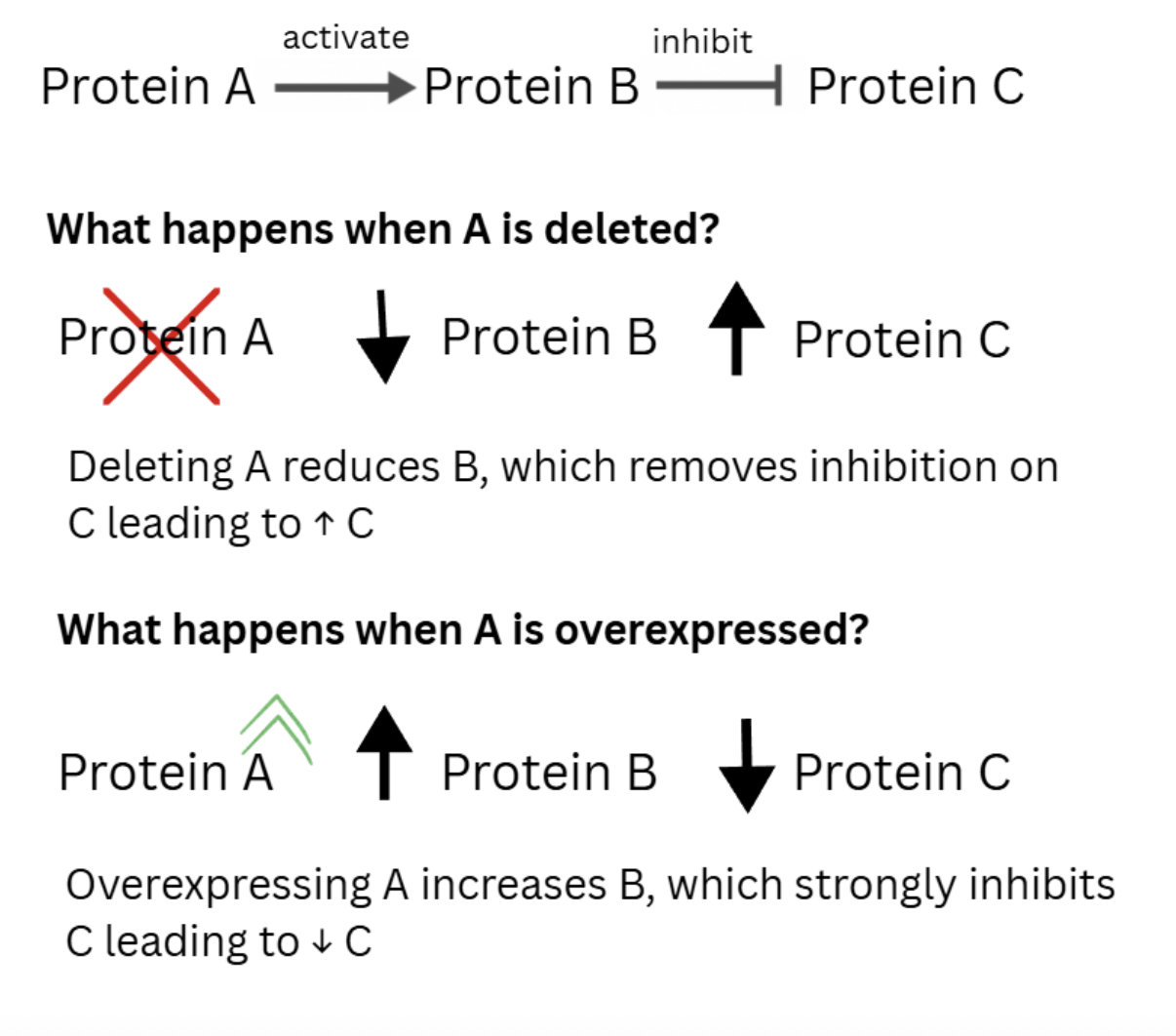
Even with a simple three-protein pathway, you can see how deleting or overexpressing one protein affects the others. This is exactly the kind of reasoning that the MCAT tests.
I encouraged students to create simple diagrams when they encounter transcription factors or enzyme cascades. Use arrows for upregulation and bars for downregulation. Even 15 to 30 seconds of quick sketching can make it much easier to analyze the setup and quickly answer mechanistic questions later.
This approach keeps you focused on understanding system and logic, insteading of getting lost in individual details. The MCAT rewards your ability to reason through outcomes, not how many flashcards you’ve memorized.
Need help with learning how to diagram out passages? Check out our Science Passage Strategy course!
2. Read Graphs and Figures Strategically
Graphs and figures can feel intimidating at first glance, especially when they include multiple variables or dense data. Many students lose valuable time trying to interpret every single point or bar before even getting to the questions.
When you first encounter a figure, start with a quick scan rather than a deep dive. Look for what type of data is being presented and what the axes represent. The axes are your best guide because they identify the independent and dependent variables. Once you know what is being manipulated and what is being measured, the purpose of the experiment becomes much clearer.
Next, look for overall trends instead of getting stuck on small fluctuations. Ask yourself, “What happens as variable X increases? How does Y respond?” You are not expected to calculate precise values; you are expected to understand relationships. Try to identify the general direction or shape of the relationship (e.g. linear, sigmoidal, inverse) without worrying about exact values.
One efficient habit is to link each figure back to the hypothesis mentioned in the passage. The data will either support or challenge that hypothesis, and that is exactly the logic the AAMC expects you to follow. Keeping the hypothesis in mind prevents you from treating each figure as random information and helps you stay focused on the story the data is telling.
Finally, do not spend time overanalyzing a figure unless a question refers to it. Many visuals exist to provide background context rather than to be tested directly. By skimming efficiently and returning with purpose, you save time while staying ready to interpret the data when it actually matters.
Need more help with learning how to break down complicated figures? Check out our Science Passage Strategy course!
3. Highlight Mechanistic Keywords
Some of the most important clues in Bio/Biochem passages are hiding in plain sight. Words like inhibition, activation, mutation, overexpression, or binding are not just background info, they are flashing lights, warning you to pay attention. They explain how different parts of a system are interacting, and often show up again directly or indirectly in the questions.
As you read, make it a habit to highlight or mentally flag these types of terms. This helps you build a clear mental map of what's happening, especially in dense passages where multiple players are interacting. It also saves time later, and may limit the amount of times you need to sketch out pathways. When a question asks about a downstream effect or mechanism, you’ll know exactly where to look in the passage without re-reading everything.
Also, be selective in what you choose to highlight. Not everything in a passage is equally important, and more than a few highlights per paragraph will make highlighted terms stand out less. Focus on the mechanistic verbs and phrases that affect experimental outcomes, molecular interactions, or pathways. These are the building blocks for most Bio/Biochem reasoning questions.
Will reading improve my MCAT score? Find out here!
4. Let the Passage Guide Your Thinking
One of the easiest ways to lose points in Bio/Biochem is relying too much on what you remember from class or flashcards, rather than what the passage actually says. You might assume a drug lowers inflammation because that’s what you learned, but if the passage says it increases inflammation in this scenario, that’s the version you need to work with.
The MCAT rewards your ability to analyze new information, not repeat what you’ve memorized. If something in the passage contradicts your background knowledge, go with the passage. Ask yourself, “What is true in this specific scenario and best answers this question?” and let that guide your answer.
This mindset helps you avoid second-guessing and stick to what the question is testing. When in doubt, choose the option that is best supported by the passage, not the one that simply sounds familiar.
5. Train Yourself to Reframe Questions
Many Bio/Biochem questions sound more complicated than they are . Your job is to cut through the technical wording and figure out what the question is really asking.
For example: “What peptides are most likely to elute first from a cation exchange column at the lowest NaCl concentration?”
Rephrased: “Which peptide is least positively charged?”
Rewording questions in your own terms helps you focus on the logic instead of getting stuck in dense phrasing. It also helps you spot common traps, like choosing an answer that’s technically correct but doesn’t match the question’s intent.
Practice asking:
- What concept is this testing?
- What’s the simplest version of this question?
- Can I reduce it to a cause-effect decision?
This approach makes even complex questions feel manageable.
6. Predict Before You're Asked
One of the best habits to build in Bio/Biochem is predictive reading. Instead of waiting for the questions to highlight what matters, try to anticipate them as you read.
Pause every few paragraphs and ask:
- What’s the key idea here?
- How could this be tested?
- What concept is being introduced?
Details like “competitive inhibitor” or an unusual experimental result are likely to show up later. By thinking ahead, you’ll stay engaged and better prepared for what’s coming.
This also helps with elimination. If two choices look tempting, compare them against what you expected based on the passage. Often, one will match the logic more directly, while the other feels like a guess.
Over time, you’ll recognize familiar question patterns and feel more in control of the test — instead of reacting to it.
Conclusion: Read Passages Like a Scientist
Mastering Bio/Biochem isn’t about memorizing more. It’s about thinking differently. The MCAT rewards students who can read like researchers — who can interpret data, predict outcomes, and reason through systems, even when the content feels unfamiliar.
If you’ve been focusing mostly on content review, this is your reminder that applying that knowledge under pressure is the real test. Ask yourself: What’s being manipulated? What’s the downstream effect? What’s the logic behind this setup? These are the questions that get you from a 125 to a 130+.
If you want help building this mindset, MCAT Self Prep offers free and low-cost tools designed specifically for strategy training. The Science Strategy Course dives deep into experimental reasoning, while 1-on-1 tutoring gives you personalized guidance on applying logic in real time.
You can also book a free 10-minute consultation to talk through your study plan and see what next steps make sense for you.
 Want more FREE MCAT help?
Get free access to our 10 content modules based on the official AAMC outline, our 300+ hour video collection, and hundreds of AAMC-style flashcards and practice questions by joining our free MCAT Prep Course! Get started here!
You’ve got this.
Alyssa Liu


For more MCAT Tips:
Sign up for our affordable elite MCAT tutoring.
Sign up for our FREE MCAT Prep Course.
Follow us on:


 seconds